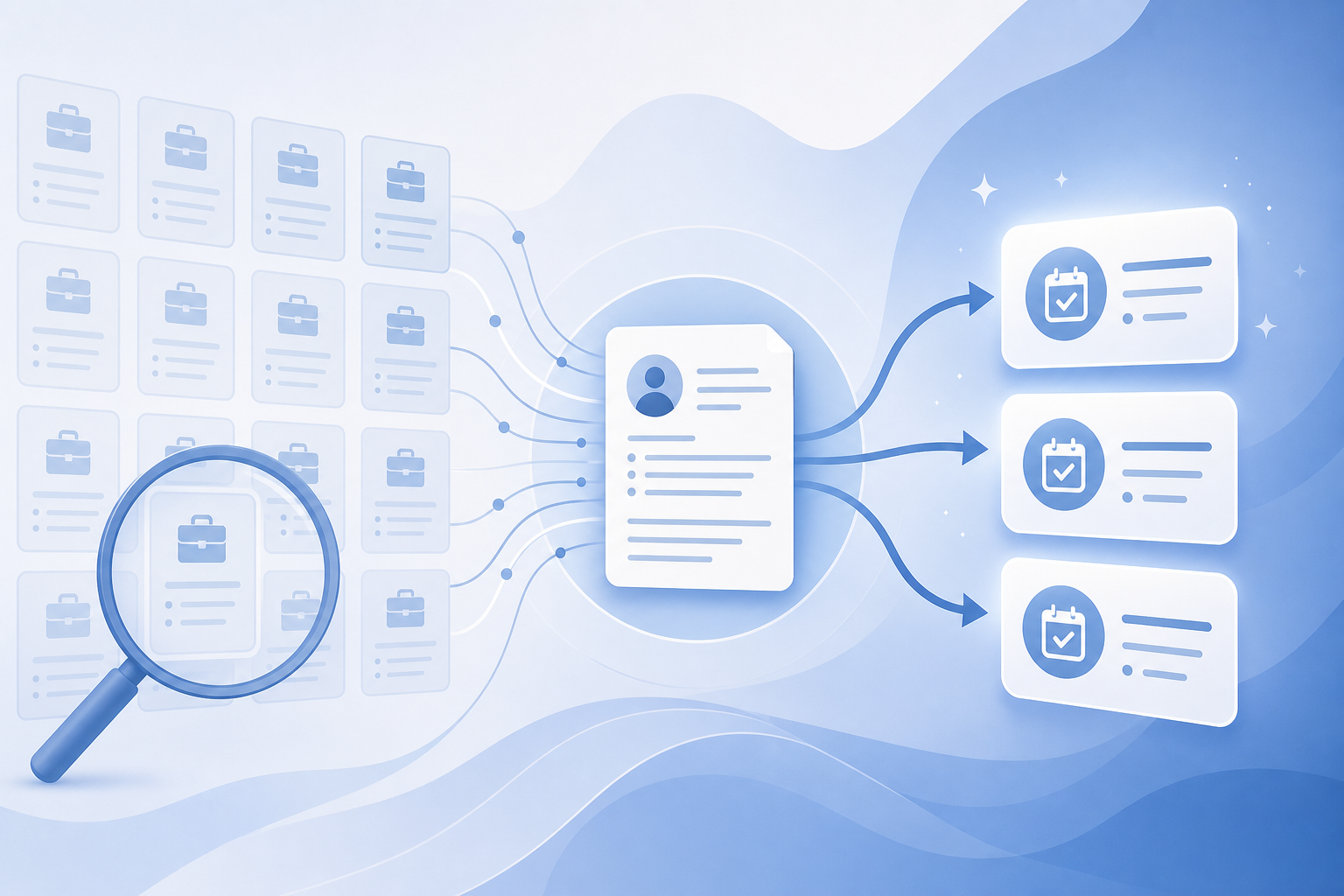
Most job seekers treat job boards like a shotgun approach. They apply to dozens of listings with the same generic resume and wait. That wastes time and lowers interview rates. With a recruiter-aware, tactical system you can convert job-board listings into real interviews without burning through weeks of applications.
Think of job boards as a conversion funnel
Job boards provide volume but also noise. The difference between a worthless application and an interview is often a single targeted sentence or a well-placed keyword. Treat the listing as the landing page and your resume as the conversion asset. Your goal is to align your resume to the listing fast and clearly so both ATS software and a busy recruiter can see the match within seconds.
Why this matters now
Applying more is not the same as applying smarter. A few high-quality, tailored submissions will outperform dozens of generic ones. That is especially true when roles are competitive or when you are changing fields and need to surface transferable strengths.
Step 1: Pick the right listings
- Normalize titles. Different companies use different titles for similar roles. Map 3 similar titles you are qualified for and search those specifically.
- Screen by must-haves. Scan the job description for required qualifications and decide if you meet the core must-haves. If you miss two or more must-haves, deprioritize the listing.
- Prioritize based on conversion potential. Favor roles with clear responsibilities, specific deliverables, and few vague requirements. Those are easier to match and convert.
- Company signals. Quick checks: company size, hiring urgency language, recent funding or hiring spree indicators. Use these to triage where to spend tailoring time.
Step 2: Reverse-engineer the job description
Open the job description and pull three classes of text: must-have skills, frequently repeated words or phrases, and the primary outcomes the role is expected to deliver. Those are your conversion cues.
- Highlight must-haves. These are often under qualifications or requirements. If you have them, put them in your top skills or summary line.
- Extract role outcomes. Turn responsibilities into achievement-style bullets on your resume that mirror the job language.
- Capture keywords. Note exact phrasing for tools, certifications, methodologies, and metrics terms. Use those phrases naturally in your bullets.
Step 3: Format for ATS and humans
Simple, consistent formatting helps ATS parse your resume and helps recruiters scan it in under 10 seconds. Focus on clarity and hierarchy.
- File type. Use PDF unless the job board explicitly requests DOCX. A clean PDF preserves layout without hidden characters. If a form requires text, paste plain text into the fields.
- Headings. Use common headings: Work Experience, Education, Skills, Certifications. Avoid creative headings that ATS may not recognize.
- Fonts and layout. Use a standard font, single column layout, and clear section dividers. Avoid images, tables, text boxes, and complex columns.
- Contact info. Include name, phone, email, city and state. Do not include full address. Avoid including recruiter-unfriendly links or mascots.
- Keywords in context. Place keywords in the experience and skills sections. Avoid stuffing. A keyword in a quantified achievement carries more weight than a list entry.
Step 4: Fast tailoring workflow you can repeat
Tailoring does not have to take hours. Build modular content and a 10 to 20 minute tailoring loop.
- Core resume. Maintain a master resume with full achievements and metrics. This is your source of truth.
- Role module bank. Create 5 to 7 modular bullets per common skill or outcome you sell. Tag them by keyword and outcome.
- 10 minute tailoring checklist.
- Update title and summary to match the job title or close variant.
- Swap or reorder 3 bullets in your top experience to mirror the job outcomes.
- Add 2 exact keyword phrases from the JD in your skills or bullets.
- Adjust one metric or result to better match the scale the employer seeks.
- Save as PDF and copy key points into the application form fields.
- Batch tailored applications. Tailor for 5 to 10 high-priority listings in a session rather than doing single, scattered edits for each application.
Step 5: Apply smartly and follow up
- Track applications. Use a simple spreadsheet with columns: role, date applied, tailoring notes, recruiter name, status. Track apply-to-interview rate to measure what works.
- Follow-up timeline. Send a concise note 7 to 10 days after applying if no status update. Keep it polite, reference the role, and restate one short achievement that matches the JD.
- Targeted outreach. If you can find the hiring manager or recruiter on LinkedIn, send a short message that references the posting and a single relevant accomplishment. Do not paste your resume into the message.
Recruiter-aware resume tactics
- Lead with impact. Start experience bullets with the result, then explain how. Recruiters skim for outcomes and numbers.
- Prioritize relevance. Put the most relevant experience near the top. If you are changing careers, create a concise "Relevant Experience" section above full history.
- Use role language. Mirror the job description wording for tools and methodologies, but keep it natural and honest.
- Quantify selectively. Metrics matter. Use percentages, dollars, headcount, time savings, or scale when possible. If exact numbers are sensitive, use ranges or relative terms like "high single digit" or "mid five figures" when appropriate.
- Remove filler. Cut generic phrases like "team player" and "hard worker" unless you back them with examples.
Quick tailoring checklist
- Match job title in resume headline or summary.
- Include 3 to 5 exact keyword phrases from the JD.
- Show 1 to 2 quantified results aligned to the role outcomes.
- Keep format simple and ATS friendly.
- Save and name your file clearly: Lastname-Company-Role.pdf
Templates and shortcuts that save time
Create two templates: a technical template and a strategic template. Each should include a short summary line, 4 to 6 core skill bullets, and modular achievement bullets you can swap in. Use copy snippets for common application fields like "Why are you interested" and tailor one sentence to the company every time.
Automate what does not require creativity. Use canned responses for follow-ups and a consistent file naming convention. Reserve your creative energy for the bullets that directly address the job outcomes.
Measure, iterate, and scale
Track which tailored approaches yield interviews. Try small experiments: one application with full tailoring vs one with minimal tailoring. Compare responses and refine your module bank. Over time you will learn which keywords, formats, and metrics convert best in your target market.
Founder perspective and next steps
As a founder focused on helping busy job seekers, I designed this playbook to be repeatable under real time pressure. The fastest path to interviews is not more volume but better alignment. Build a modular resume system, prioritize high-conversion listings, and make tailoring a short, routine step.
If you want to speed the tailoring loop, consider tools that extract keywords from job descriptions and let you assemble targeted resumes in minutes. Those tools are most helpful when they support a manual quality check so your resume stays honest and recruiter-friendly.
Start today: pick five high-potential listings, spend a focused hour building your module bank, and apply to the top three with targeted resumes. Track results and iterate. Small, consistent improvements in alignment produce real interview outcomes.
FAQ
- How many jobs should I apply to each week? Quality over quantity. Aim for 10 to 20 targeted applications a week using the tailoring workflow. If you are early in a career change, focus on fewer, more fully tailored applications until you see traction.
- Will ATS reject my resume if I use a template? Not if the template is simple and ATS friendly. Avoid images, tables, and unconventional headings. Use standard section titles so parsing is reliable.
- How long should tailoring take? A good target is 10 to 20 minutes per application after you build your master resume and module bank.
- Should I copy job description phrases exactly? Use exact phrases for skills and tools where relevant. For achievements, mirror the outcome language but write authentic bullets that reflect your work.