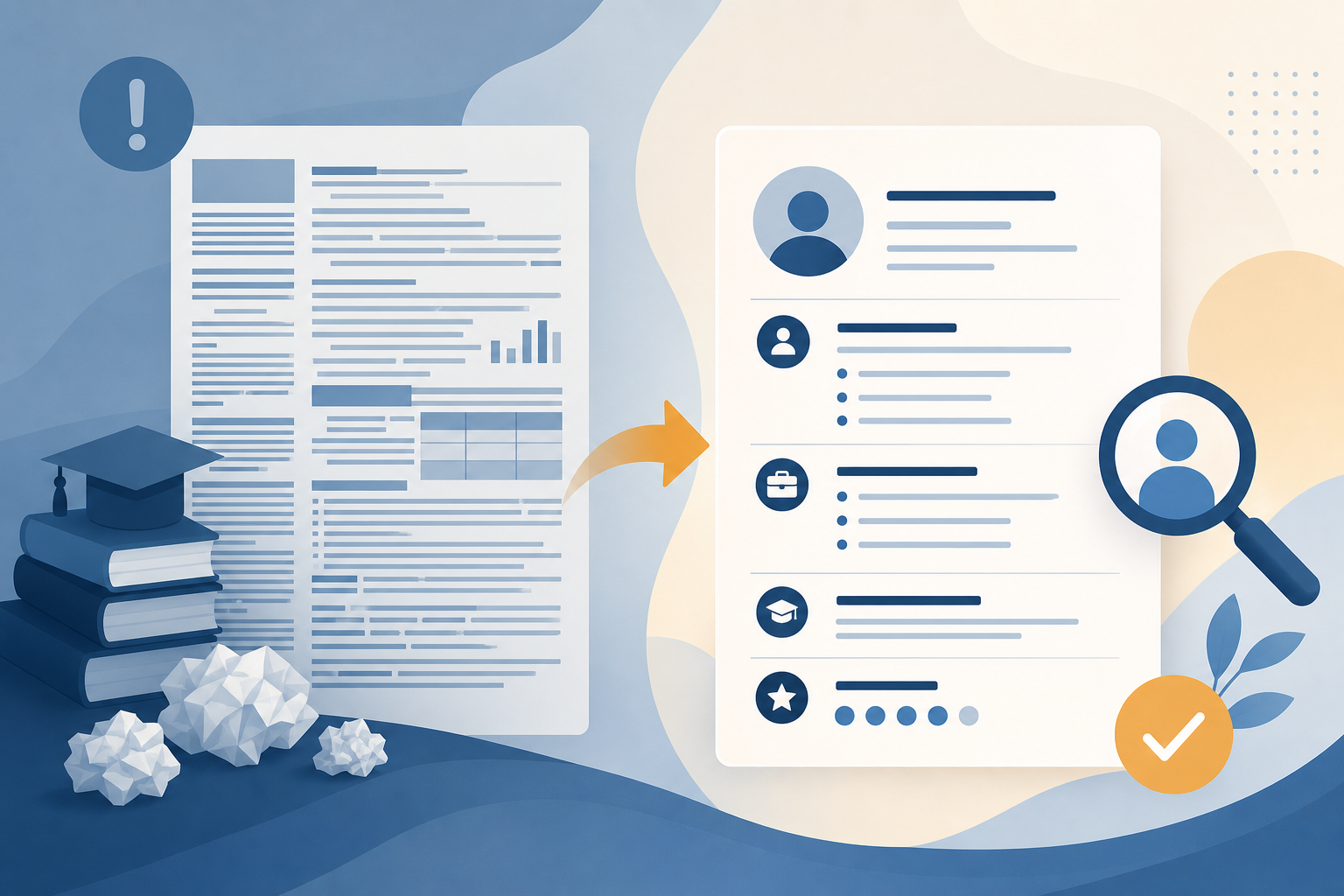
CV or Resume? Choose the Right Document for Your Job Search
Confusion between CV and resume costs time and attention. Recruiters and hiring systems expect different documents in different contexts. This guide gives clear, practical rules for when to send a CV versus a resume, what hiring managers and ATS really read, and a 15-minute conversion checklist with ready-to-use wording for career changers and recent graduates.
Quick rule summary
- Use a resume for most corporate, startup, and non-academic roles - concise, tailored, 1 to 2 pages.
- Use a CV for academic, research, scientific, medical, or grant-funded roles - comprehensive, chronological, often multi-page.
- When in doubt follow the job posting. If it asks for a CV, send a CV. If it asks for a resume or does not specify, send a tailored resume.
When to send a CV
- Applying for faculty positions, postdoctoral roles, research scientist jobs, or academic fellowships.
- When the employer requests a full list of publications, grants, teaching experience, licenses, or detailed research history.
- For roles that require a complete career history and scholarly record.
When to send a resume
- Most corporate roles, product, engineering, marketing, operations, HR, finance, and design jobs.
- When recruiters screen dozens to hundreds of applicants - concise relevance wins.
- For career changes where you need to highlight transferable skills and recent, relevant accomplishments.
Regional and sector notes
- In the United States and Canada, "resume" is the default for non-academic roles. In the UK, Ireland, and many Commonwealth countries, "CV" often means the one- to two-page resume-equivalent. Always check the job posting.
- Some government and civil service applications use longer, CV-style profiles even for non-academic roles.
ATS and format implications
Applicant tracking systems parse content before any human sees it. Formatting choices affect parsing, keyword detection, and whether your experience appears in searchable fields.
- File type: Use PDF for external applications when layout matters, unless the job explicitly requests a Word document. Some older ATS prefer .docx, so follow instructions exactly.
- Layout: Use standard headings like "Experience," "Education," "Skills," and "Publications." Avoid headers and footers for critical content because some ATS skip them.
- Avoid images, graphics, text boxes, and complex tables. Those often break parsing.
- Use keywords from the job description naturally in role bullets and skills. Repeat critical phrases in context - not as a keyword dump.
- Length: Resumes 1 to 2 pages. CVs can be longer and more detailed for academic roles.
- Fonts and characters: Use common sans serif fonts and standard characters. Unusual symbols or emojis can break ATS matching.
Recruiter-aware content strategy
- Lead with a one-line headline or summary for resumes to orient a recruiter in seconds.
- Highlight the last 10-15 years of relevant experience first. Older roles can be summarized or moved to a separate section.
- Use achievement-focused bullets: context, action, outcome. If you cannot provide a hard metric, describe the outcome qualitatively.
- Tailor the top third of the resume to the job - that's where recruiters decide whether to continue reading.
15-minute conversion checklist - turn a CV into an ATS-friendly resume
Follow this checklist in order. It is built for speed so you can convert a long CV into a recruiter-ready resume in 15 minutes.
- Set document length and file type
- Trim to 1 to 2 pages for non-academic roles.
- Save as PDF unless the application requires .docx.
- Change the title
- Replace "Curriculum Vitae" with a role-focused headline: Example - Product Manager - Data-driven product leader.
- Create a 1-line professional summary
- Career changer example: "Operations leader transitioning to product - background in process optimization, cross-functional leadership, and user research."
- Recent grad example: "Computer science graduate with internship experience in backend development and API design, seeking entry-level software engineer role."
- Pull top relevant roles forward
- Keep only roles that support the target job. Summarize older or unrelated roles into a short "Earlier Experience" line.
- Convert academic entries into transferable bullets
- Academia: "Designed and implemented data pipeline for research project" becomes resume bullet: "Built data pipeline to support analysis for multi-year research project, improving data availability for stakeholders."
- Write achievement bullets
- Use this structure: Context - Action - Outcome. Template: "[Action] to [achieve result], which resulted in [outcome]." Example for career changer: "Led cross-functional team to redesign customer onboarding, reducing onboarding time and improving first-week engagement."
- If you have metrics, insert them: "Reduced processing time by [X]%". If not, use qualitative outcome: "improved processing time".
- Extract and list keywords
- Scan the job posting and add 6 to 10 relevant keywords into your Skills and top bullets, naturally and accurately.
- Simplify formatting
- Use standard headings, bullet lists, and no images or fancy columns. Ensure contact info is plain text at the top.
- Tailor the top third
- Customize the summary, 2 to 3 bullets, and skills for the specific role before applying.
- Proofread and run an ATS check
- Quick read for spelling and consistent tense. Use an ATS preview or scanner if you have one to confirm parsing.
Ready-to-use wording blocks
Copy and paste these templates and edit the bracketed items. Keep the voice concise and recruiter-friendly.
- Resume headline (1 line)
- Career changer: "Operations Manager moving into Product Strategy - cross-functional leadership, process design, user research."
- Recent grad: "Entry-level Software Engineer - backend development, API design, and test automation."
- Professional summary (2 to 3 lines)
- Career changer: "Results-driven operations leader with [X] years improving process efficiency and leading cross-functional teams. Seeking to apply analytical and product-focused skills to product management roles."
- Recent grad: "Computer science graduate with internship experience building REST APIs and automated tests. Strong foundation in [languages], teamwork in Agile environments, and a drive to learn production-scale systems."
- Achievement bullet templates
- "Led [team size] to [action], resulting in [outcome]."
- "Implemented [tool/process] to [action], improving [metric or outcome]."
- "Designed and delivered [project] that supported [stakeholder or goal]."
- Skill line example
- Skills: Product Roadmapping, Data Analysis, Cross-functional Leadership, SQL, A/B Testing, Agile.
Practical checklist for recent grads
- Lead with a project or internship if you lack full-time experience.
- Include course or team project only if directly relevant; describe your role and outcome.
- Use a short technical skills section with primary languages and tools first.
- Use the ready-to-use bullets above and replace placeholders with concise facts.
Common pitfalls to avoid
- Sending an unedited academic CV to a recruiter - too long and unfocused for non-academic roles.
- Keyword stuffing - it reads poorly to humans and can trigger ATS false positives.
- Overdesigning - creative resumes are fine for design roles, but complex layouts break ATS parsing for most jobs.
Founder perspective
Recruiters decide whether to progress an application in seconds. That reality shaped how ResumeRescue.io was built: to turn long-form career documents into focused, ATS-ready resumes that highlight what hiring teams care about. The goal is practical clarity - not gimmicks - so applicants can move faster and with more confidence.
If you prefer to implement the checklist yourself, follow the steps above. If you want to save time, ResumeRescue.io offers AI-powered conversion and ATS checks that apply these exact rules so you can submit a tailored resume in minutes.
FAQ
- Can I use my CV as my resume?
Yes, but you must edit and condense it. Remove exhaustive academic details, focus on relevant roles, and create achievement-focused bullets for a resume format.
- How long should my resume be?
One to two pages for most professionals. Keep to one page if you are an early career candidate; use two pages if you have 10 or more years of relevant experience.
- Should I include publications and grants?
Include them on a CV for academic roles. For non-academic resumes, include only publications or grants that are directly relevant and summarize them briefly.
- Is PDF always safe for ATS?
Most modern ATS parse PDFs fine, but some older systems prefer .docx. Always follow the application instructions exactly.
Choosing the right document is mostly about context and clarity. Use this guide and the 15-minute checklist to convert long career narratives into crisp, recruiter-ready resumes that pass ATS checks and get human attention. When speed matters, the right format and a tailored top third make the difference.